Alpesh Kumar
Image
  • Home
  • Blog
Alpesh Kumar
  • Home
  • Blog
Image
  • Home
  • Blog

Blog

Home/Blog/Page 3
Layered AI agent architecture with a visible trajectory moving through reasoning, tools, sandbox, monitoring, and human approval controls
Artificial Intelligence

GPT-6 Astra Didn’t Break AI. It Revealed What Was Already Broken.

Read more
iPhone 18 Pro Max - A Closer Look at the Camera, Power and Possibilities
Photography

iPhone 18 Pro Max. See the Shot. Learn the Settings. Make It Yours.

Read more
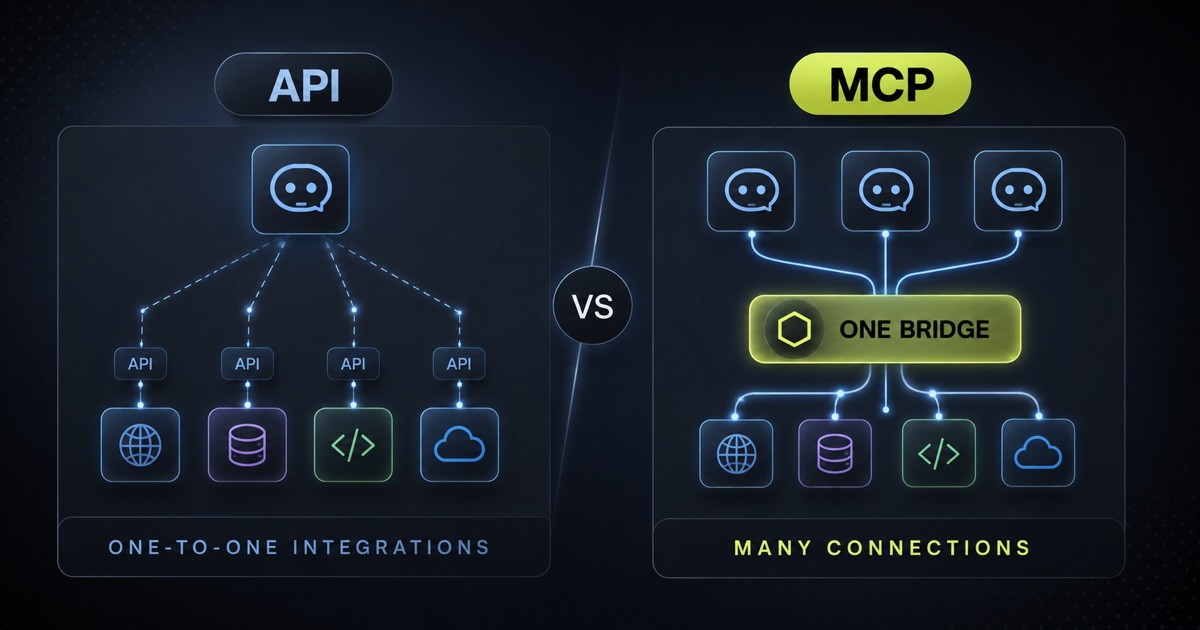
Diagram comparing traditional API integrations with an MCP server connecting AI clients to multiple tools
AI Agents, Software Architecture

MCP vs API: What’s the Difference, and How Do They Work Together?

Read more
A magnifying glass examines a circled em dash beside the headline A dash of suspicion, illustrating doubts about AI authorship.
Artificial Intelligence

Should We Really Be Afraid of an Em Dash?

Read more
Architectural blueprint for building ChatGPT apps
Artificial Intelligence

Games with Astra: How AI Is Changing Game Development

Read more
OpenAI Claims We’re in the “AGI Era.” The Catch? It Costs $20,000 Per Test
AI Agents, Artificial Intelligence, LLM

OpenAI Claims We’re in the “AGI Era.” The Catch? It Costs $20,000 Per Test.

Read more
Design Uber’s AI Demand Prediction and Driver Repositioning System
Artificial Intelligence, Machine Learning, System Design

Design an Uber Demand Prediction and Driver Repositioning System

Read more
AI Agent Frameworks Compared: Vercel AI SDK, LangGraph, CrewAI, AutoGen and LangChain — a framed comparison diagram visually separates streaming provider-flexible TypeScript output, branching and resumable orchestration, role-based collaboration, conversational agents, and modular integration building blocks, showing why framework selection follows architecture rather than a universal winner.
AI Agents, Artificial Intelligence, LangGraph

AI Agent Frameworks Compared: Vercel AI SDK, LangGraph, CrewAI, AutoGen and LangChain

Read more
AI Watermarks Are Not a Silver Bullet: What Provenance Signals Can and Cannot Prove — a warm ivory technical diagram shows a media file with an embedded watermark band and a linked provenance record feeding an evidence tray, then stopping before separate source, context, and corroboration checks, representing that C2PA metadata and watermarks inform origin but cannot independently prove accuracy, ownership, or context. Visual direction: idea: provenance signals are useful evidence but stop short of editorial truth; subject: C2PA Content Credentials and embedded AI watermarking; mechanism: a media file carries an embedded watermark while a separate provenance record supplies origin/history information, both entering an evidence tray before a hard boundary requiring source, context, and corroborating-evidence checks; composition: landscape editorial explainer card with the exact headline in the upper third and a lower horizontal proof-boundary schematic; palette: warm ivory, ink charcoal, muted brick red, moss green, soft ochre, pale stone gray; exclusions: dark navy, neon-blue glow, floating UI cards, network nodes, generic AI circuitry, people, robots, hands, dashboards, physical-machine metaphors, decorative charts, logos, secondary readable text.
Artificial Intelligence

AI Watermarks Are Not a Silver Bullet: What Provenance Signals Can and Cannot Prove

Read more
The UUID Primary Key Problem That Shows Up at 200 Million Rows — a framed technical comparison shows a random UUID B-tree scattering inserts and a point lookup fanning into many cold row pages, contrasted with a time-ordered UUID path that keeps inserts and fetched pages locally clustered. Visual direction: idea: a UUID primary-key lookup can find the key quickly yet still cause extreme page reads when random insertion order scatters the B-tree and cold row pages; subject: UUID primary keys at 200 million rows; mechanism: compare random UUID insert distribution across many B-tree leaf pages with time-ordered UUID inserts concentrated at the active edge, then show a point lookup descending the index and fanning out into scattered cold data pages marked by a dense 94,000-read texture; composition: framed comparison — a generous title band across the top, with a large left diagnostic zone for random UUID scatter and a right diagnostic zone for ordered UUID locality, joined only at the bottom by one shared lookup-to-row path; palette: deep forest/moss — pale eucalyptus background, forest-green and near-black ink, muted sandstone page blocks, restrained burnt-orange I/O accents, and a small burgundy warning accent; exclusions: dark navy, neon-blue glow, floating UI cards, network nodes, generic AI circuitry, people, robots, hands, dashboards, logos, fake code, secondary readable text, decorative charts, physical-machine metaphors
System Design

The UUID Primary Key Problem That Shows Up at 200 Million Rows

Read more
Your First Personal AI Agent: A Focused Weekend Build — a warm cream technical schematic shows current-week meeting notes constrained by an agent contract, optionally checked against one read-only source, transformed into a structured priorities draft, and stopped at a human approval boundary before any external action; visual direction: idea: a first personal AI agent produces a reviewable weekly-priorities draft from tightly bounded meeting notes, with no autonomous external action; subject: focused personal AI-agent weekend build; mechanism: current-week notes pass through a clearly labelled contract boundary and one limited read-only lookup into a structured priorities draft, then stop at an explicit human approval gate before any external-action area; composition: landscape editorial explainer card with the exact title large across the upper third and a lower left-to-right paper-like workflow schematic, ending at a prominent approval stamp boundary and a muted crossed-out external-action zone; palette: warm cream background, charcoal typography, oxblood red boundary accents, muted olive green for approved draft, dusty apricot for source notes, slate gray connectors; exclusions: dark navy, neon-blue glow, floating UI cards, network nodes, generic AI circuitry, people, robots, hands, dashboards, physical-machine metaphors, decorative charts, logos, secondary readable text.
AI Agents, Artificial Intelligence

Your First Personal AI Agent: A Focused Weekend Build

Read more
Build an AI Agent Evaluation Flywheel That Improves Prompts — a text-free circular technical schematic shows recorded agent traces being separately evaluated for outcomes and trajectories, classified into recurring failure types, turned into prompt candidates, and checked against development, hold-out, and regression cases before feeding evidence back into the next run. Visual direction: idea: a trace-aware evaluation loop turns recurring agent failures into verified prompt changes; subject: AI agent evaluation flywheel; mechanism: captured tool traces flow through separate outcome and trajectory evaluation, failure taxonomy, prompt variants, and hold-out/regression verification with a safety gate; composition: a single clockwise five-stage circular schematic with evidence records at the top and a verification boundary closing the loop; palette: warm off-white, graphite, deep forest green, muted rust, clay orange, restrained golden yellow; exclusions: dark navy, neon-blue glow, floating UI cards, network nodes, generic AI circuitry, people, robots, logos, readable artwork text.
AI Agents, Artificial Intelligence

Build an AI Agent Evaluation Flywheel That Improves Prompts

Read more
1 2 3 4 … 7

©alpeshkumar.com , All rights reserved

We use essential cookies to operate this website and remember your privacy choices. With your permission, we also use analytics and advertising cookies to understand website use and support relevant advertising. You can accept all, reject optional cookies, or manage your choices at any time.

Alpesh Kumar
Powered by  GDPR Cookie Compliance
Privacy Overview

This website uses cookies so that we can provide you with the best user experience possible. Cookie information is stored in your browser and performs functions such as recognising you when you return to our website and helping our team to understand which sections of the website you find most interesting and useful.

Strictly Necessary Cookies

Strictly Necessary Cookie should be enabled at all times so that we can save your preferences for cookie settings.

Additional Cookies

This website uses the following additional cookies:

(List the cookies that you are using on the website here.)

Cookie Policy

More information about our Cookie Policy