

Alpesh Kumar
Image
  • Home
  • Blog
Alpesh Kumar
  • Home
  • Blog
Image
  • Home
  • Blog

Monthly: July 2026

Home/2026/July
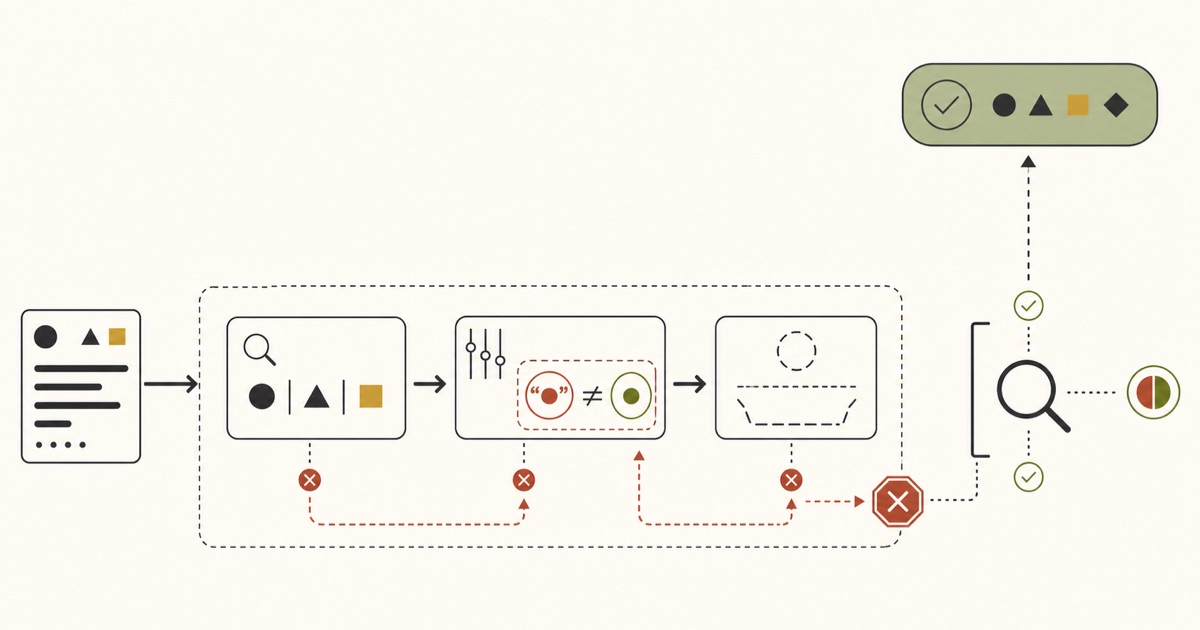
Why Final-Answer Evals Leave AI Agent Failures Invisible — a warm editorial execution-trace schematic contrasts a reassuring green final-response indicator with the visible failed path beneath it: wrong tool selection, a quoted-number parameter mismatch, and a missing update state, all examined by a trajectory evaluator. Visual direction: idea: an apparently successful answer hides a failed execution path; subject: AI-agent trajectory evaluation; mechanism: evaluator compares final claim with recorded tool selection, typed arguments, missing action, and state transitions; composition: left-to-right audit strip beneath a detached green outcome capsule with an inspection bracket; palette: warm ivory, charcoal, muted sage, terracotta, ochre; exclusions: dark navy, neon-blue glow, floating UI cards, network nodes, generic AI circuitry, people, robots, logos, readable artwork text.
AI Agents, Artificial Intelligence, Software Architecture

Why Final-Answer Evals Leave AI Agent Failures Invisible

Read more
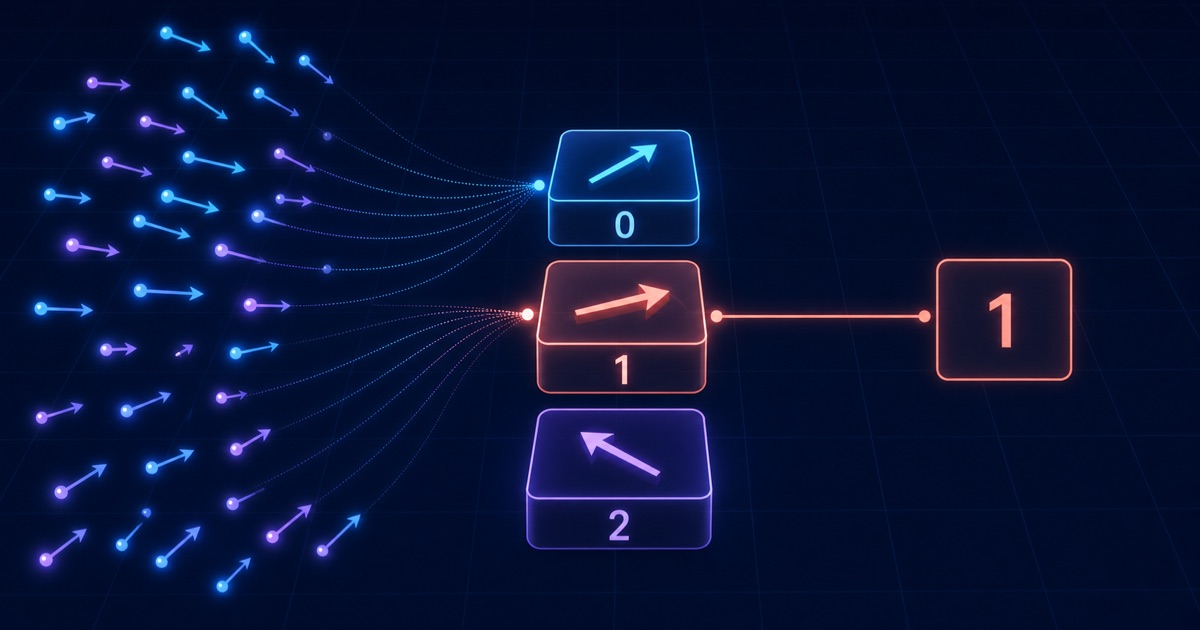
Vector Quantisation: How Code Books Compress Similar Data — an illustrated flow of many similar input vectors being matched to a small numbered code book, then represented by one compact index to show lossy shared-dictionary compression.
Machine Learning

Vector Quantisation: How Code Books Compress Similar Data

Read more
Contextual Retrieval: Anthropic’s Approach to Reducing RAG Retrieval Failures — an abstract knowledge-retrieval scene shows incomplete document fragments gaining contextual metadata before semantic and keyword paths converge on a focused result, representing how added context reduces RAG retrieval failures.
Software Architecture

Contextual Retrieval: Anthropic’s Approach to Reducing RAG Retrieval Failures

Read more
TurboVec: What This Rust Vector Index Is and How to Evaluate It — a dark technical illustration shows a glowing field of connected vector points compressing into an organized geometric index as a bright query path selects nearby vectors, representing evaluation of compressed vector retrieval.
Artificial Intelligence, Python

TurboVec: What This Rust Vector Index Is and How to Evaluate It

Read more
1 2

Categories

  • AI Agents
  • AI&ML
  • Artificial Intelligence
  • Consulting
  • LangGraph
  • LLM
  • Machine Learning
  • NASA
  • Payment
  • Photography
  • Python
  • Self-Hosting
  • Software Architecture
  • System Design

Recent Posts

  • LangGraph Persistence Tutorial: Checkpoint and Resume Multi-Agent Workflows
  • AI Product Development: Prototypes Are Cheap, Judgment Is Not
  • LangGraph Routing and Parallel Execution: Send Tasks to the Right Agents
  • LangGraph Shared State Tutorial: Control Context in Multi-Agent Systems
  • Python 3.15 Is Almost Here: 7 Features Developers Should Know

Tags

AI AI Agents AI agent security AI Architecture AI automation AI Security AI Writing Analysis Anthropic Apple Artificial Intelligence Bias-Variance Trade-off Camera Settings Classification Claude Data Decision Trees design Embeddings Ensemble Methods Gemma Google AI Information Gain iPhone 18 Pro Max iPhone Photography LangGraph LLM Machine Learning MLOps Mobile Photography Multi-agent Nomic OpenAI Overfitting Process Python Real-Time Systems Redis Regression Software Engineering System Architecture Text-to-Video Underfitting Workflow Automation Writing Tips

“ Design is not just what it looks like and feels like. Design is how it works. “

Alpesh Kumar

Image

©alpeshkumar.com , All rights reserved

We use essential cookies to operate this website and remember your privacy choices. With your permission, we also use analytics and advertising cookies to understand website use and support relevant advertising. You can accept all, reject optional cookies, or manage your choices at any time.

Alpesh Kumar
Powered by  GDPR Cookie Compliance
Privacy Overview

This website uses cookies so that we can provide you with the best user experience possible. Cookie information is stored in your browser and performs functions such as recognising you when you return to our website and helping our team to understand which sections of the website you find most interesting and useful.

Strictly Necessary Cookies

Strictly Necessary Cookie should be enabled at all times so that we can save your preferences for cookie settings.

Additional Cookies

This website uses the following additional cookies:

(List the cookies that you are using on the website here.)

Cookie Policy

More information about our Cookie Policy