
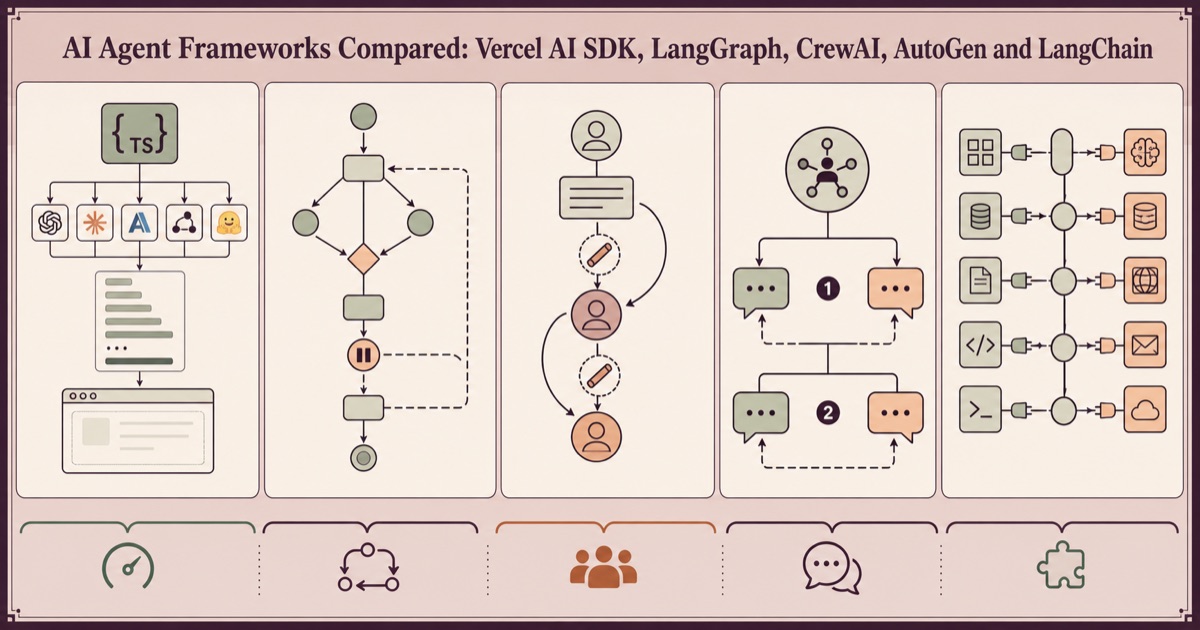
AI agent frameworks, including Vercel AI SDK, LangGraph, CrewAI, AutoGen and LangChain, are often grouped together. However, they do not solve the same problem. Choose from the architecture you need to build rather than searching for one “best” framework.
This comparison uses the supplied five-tool overview as a research prompt, not as a source of truth. Instead, use primary focus, language support and state handling as decision inputs. Versions, SDKs and integrations change. Therefore, confirm implementation details in the linked official documentation before committing to a proof of concept.
Key takeaways
- Choose Vercel AI SDK first when a TypeScript application needs provider flexibility and streamed model output.
- Choose LangGraph first when the central problem is explicit agent orchestration.
- Evaluate CrewAI and AutoGen for agent-oriented patterns, then use their current documentation for feature-level decisions.
- Finally, do not infer deployment, licensing, persistence or operational fit from a comparison table alone.
How to read AI agent frameworks
Primary focus names the problem a tool is presented to solve. In contrast, Best fit turns that focus into a starting scenario. Language describes the documented implementation surface, not every integration. Meanwhile, State and orchestration asks where workflow progress or conversation context belongs.
Those distinctions matter. For example, a UI integration helps deliver model output to a user. An agent graph describes how work can branch, loop and return. Similarly, a role-based workflow describes how specialised participants collaborate. Conversational history is another concern. As a result, a project may need more than one layer.
AI agent frameworks at a glance
| Decision axis | Vercel AI SDK | LangGraph | CrewAI | AutoGen | LangChain |
|---|---|---|---|---|---|
| Documented primary focus | Unified TypeScript SDK for AI applications, with streaming, multi-model and provider-agnostic capabilities. | Agent orchestration for reliable AI agents. | Confirm the current capability required for your use case. | Framework for building AI agents and applications. | Confirm the current building blocks and integrations required by your project. |
| Practical starting scenario | An interactive TypeScript application that streams model output. | A workflow where agent work must be explicitly coordinated. | A role-based or multi-agent workflow, after validating documentation. | A conversational single-agent or multi-agent application. | An LLM application that needs documented integrations and components. |
| Decision question | Is streamed model output needed in a TypeScript product? | Would branching, looping or resuming agent work benefit from a clear model? | Do role-based collaboration patterns match the workflow? | Is a conversational agent application the core problem? | Which application components and integrations are actually needed? |
AI agent frameworks for TypeScript streaming
Vercel describes AI SDK as a unified TypeScript SDK for AI apps with streaming, multi-model and provider-agnostic capabilities. Consequently, it is a strong starting point for a web product where responses arrive progressively in a TypeScript UI.
For example, a support interface can send a prompt to a selected model provider and render the response as it arrives. The useful decision is not simply that the product includes AI. Rather, streaming and provider choice are first-class application concerns.
The trade-off is equally important. This positioning does not itself select a durable state store, recovery strategy or orchestration model for a complex workflow. If coordinating dependent steps is difficult, evaluate that concern separately.
AI agent frameworks for orchestration
LangChain positions LangGraph as an agent orchestration framework for reliable AI agents. Accordingly, it is a practical first tool to evaluate when the main problem is the path through agent work.
Graph-based orchestration becomes relevant when a task can branch, loop for another attempt, pause for a decision or resume after an interruption. In this case, the value is the explicit workflow model, not a claim that every application needs a graph. Before choosing it, use the current LangGraph overview to validate language, storage and feature-level choices for the version you intend to run.
CrewAI, AutoGen and LangChain need a narrower verdict
It is tempting to give every comparison cell a confident label. However, the safer route is to preserve what the sources support and leave the rest to current documentation.
CrewAI’s documentation, including its introduction, is the right place to validate current claims about roles, flows, supported languages or state. Treat it as a candidate for role-based and multi-agent patterns. Then test that pattern against the capabilities your application requires.
AutoGen’s documentation describes a framework for building AI agents and applications. Its AgentChat component supports conversational single-agent and multi-agent applications. In addition, its documentation states Python 3.10 or later. The Microsoft Research AutoGen project page is a further official reference. This supports a conversational-agent starting point, not a universal verdict about state or deployment.
LangChain’s documentation should guide a general LLM application decision. Before calling it the right foundation, match its current integrations and components to the interfaces, providers and operating model your project actually needs.
Choose from your architecture, not the framework name
- Need a TypeScript application with streamed model output? Evaluate Vercel AI SDK first.
- Need explicit orchestration for an agent workflow? Evaluate LangGraph first.
- Need role-based or conversational multi-agent patterns? Compare the current CrewAI and AutoGen documentation.
- Need general LLM application building blocks? Assess LangChain alongside your required integrations.
Next, add constraints the table cannot settle: language requirements, persistence, licensing, deployment, observability, security review, cost controls and recovery behaviour. Then build a small proof of concept that exercises the riskiest workflow. It is more informative than a feature checklist.
Verdict
Vercel AI SDK is the clearest fit here for a TypeScript streaming scenario. Likewise, LangGraph is the clearest fit for an explicit agent-orchestration scenario. Neither recommendation makes one tool best for every application.
If language, state, licensing, deployment or production operations are material constraints, do not select from the supplied image alone. Instead, evaluate CrewAI, AutoGen and LangChain against their current official documentation. Finally, use the architecture checklist to choose a starting tool, verify its relevant documentation row, then build a focused proof of concept.
Categories: Artificial Intelligence, AI Agents, LangGraph
Tags: AI Agents, LangGraph, LLM, Multi-agent