
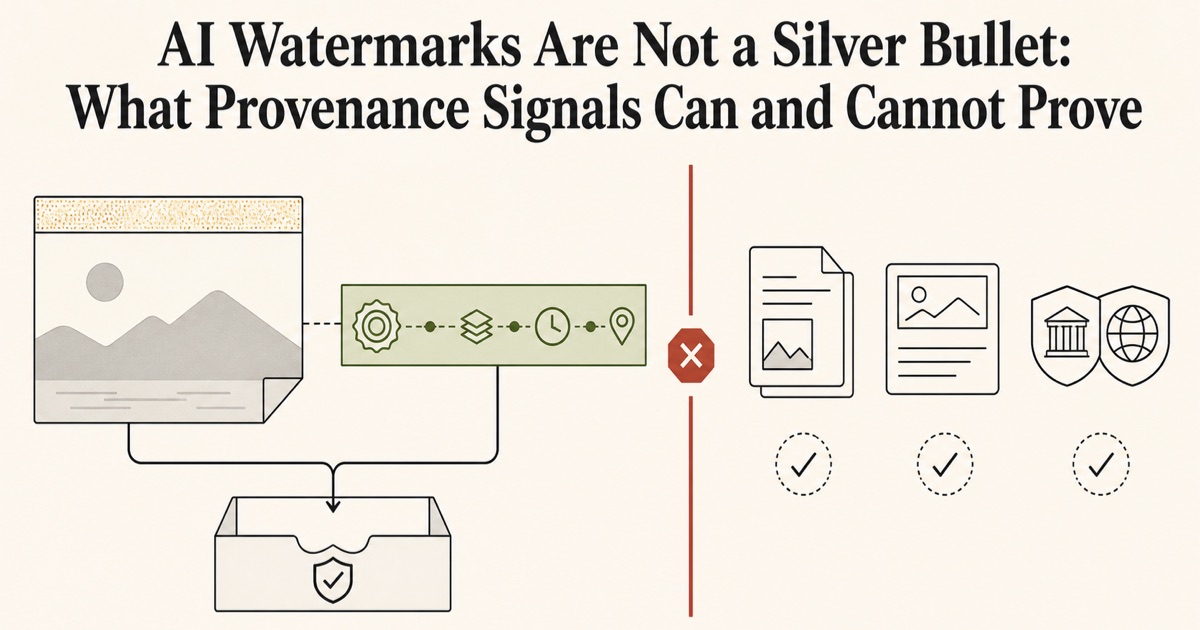
When new AI provenance signals appear in AI tools, the online reaction can feel predictable: a new lock is announced, then attention turns to whether someone can pick it. That framing misses the more useful question. What can a provenance signal actually tell a reader?
The short answer is that it can add valuable context about an image’s origin and history. However, it cannot settle every question about the image. A responsible decision still requires checking the source, the surrounding claim, and independent evidence.
Key takeaways
- AI provenance signals can include C2PA Content Credentials and embedded watermarking.
- A missing, altered, or unavailable signal is not a final verdict on an image’s origin or reliability.
- Provenance can inform a decision, but it does not prove accuracy, ownership, or context.
- The most useful approach combines available signals with source checking and corroboration.
What AI provenance signals can show
Content Credentials use the C2PA standard, an open technical standard that can embed metadata about a media file’s origin and related history. Depending on what a publisher provides, that information can include the tool or service involved in creating a file and details about its history.
This is broader than AI. Camera manufacturers, news organisations, and other publishers can use the same standard to document where media came from. As a result, readers can inspect declared provenance rather than relying only on what an image looks like.
More importantly, that distinction matters. A provenance record can be meaningful evidence, but it is not a truth label. It does not tell a reader whether every claim made beside an image is correct.
Why AI provenance signals need another layer
Metadata attaches to a file. An embedded watermark places a signal in the generated media itself. OpenAI describes SynthID as an invisible watermarking technology that can provide an additional provenance signal alongside C2PA metadata.
The two approaches can complement each other. For example, OpenAI says an embedded signal may persist through some edits or transformations, which can be useful when metadata is unavailable. This is a qualified benefit, not a promise that a signal will always be present or that readers can classify every image with certainty.
In practice, readers should treat a provenance result as one input. Do not turn the presence or absence of a single signal into a shortcut for judging the whole image.
What provenance cannot prove
OpenAI explicitly notes that provenance signals do not establish that content is accurate, unedited, legally owned, or presented in the correct context. These limits do not mean provenance has failed. Instead, they mark the boundary between technical origin information and editorial judgement.
Imagine an image shared with a confident caption about a breaking event. A provenance signal might help explain who created or handled the image. It cannot confirm that the caption is true, that the image depicts the stated event, or that the person sharing it has the rights they claim. Therefore, readers still need source checking and corroboration.
Likewise, readers should not infer too much from an unavailable signal. Files move through different services and formats. Consequently, a provenance check is not a complete review of a file’s past.
Why the arms-race story is incomplete
At the same time, it is tempting to reduce the issue to a contest between marking media and trying to evade those marks. That story produces strong headlines, but it is not a good decision framework for creators, publishers, or readers.
A more useful approach uses layers. Platforms and tools can provide provenance information. Publishers can disclose how material was made or edited. Readers can compare a claim with trustworthy reporting, the original source, and other evidence. Together, these layers make misleading presentation harder to accept uncritically.
Ultimately, this keeps the focus on the public benefit. The goal is not perfect detection or a claim that technology alone can settle disputes. Instead, the goal is to give people more context and better reasons to pause before trusting, sharing, or republishing media.
A practical rule for creators and readers
Creators and publishers should use provenance tools as part of transparent publishing, then make the surrounding context clear. Readers evaluating AI provenance signals should look for available provenance information. In addition, they should ask who supplied the image, what claim it supports, and whether independent evidence confirms that claim.
This approach is for anyone evaluating AI-generated or edited media in good faith. It is not a guide for concealing origin signals or bypassing safeguards. The safest useful first action is to check the available provenance information, then verify the source and context before relying on the image.
Use provenance signals as one piece of evidence, not a final verdict. For further detail on the signals OpenAI uses for supported content, see OpenAI’s provenance signals guidance.
Categories: Artificial Intelligence, AI Tools
Tags: Artificial Intelligence, AI Security