
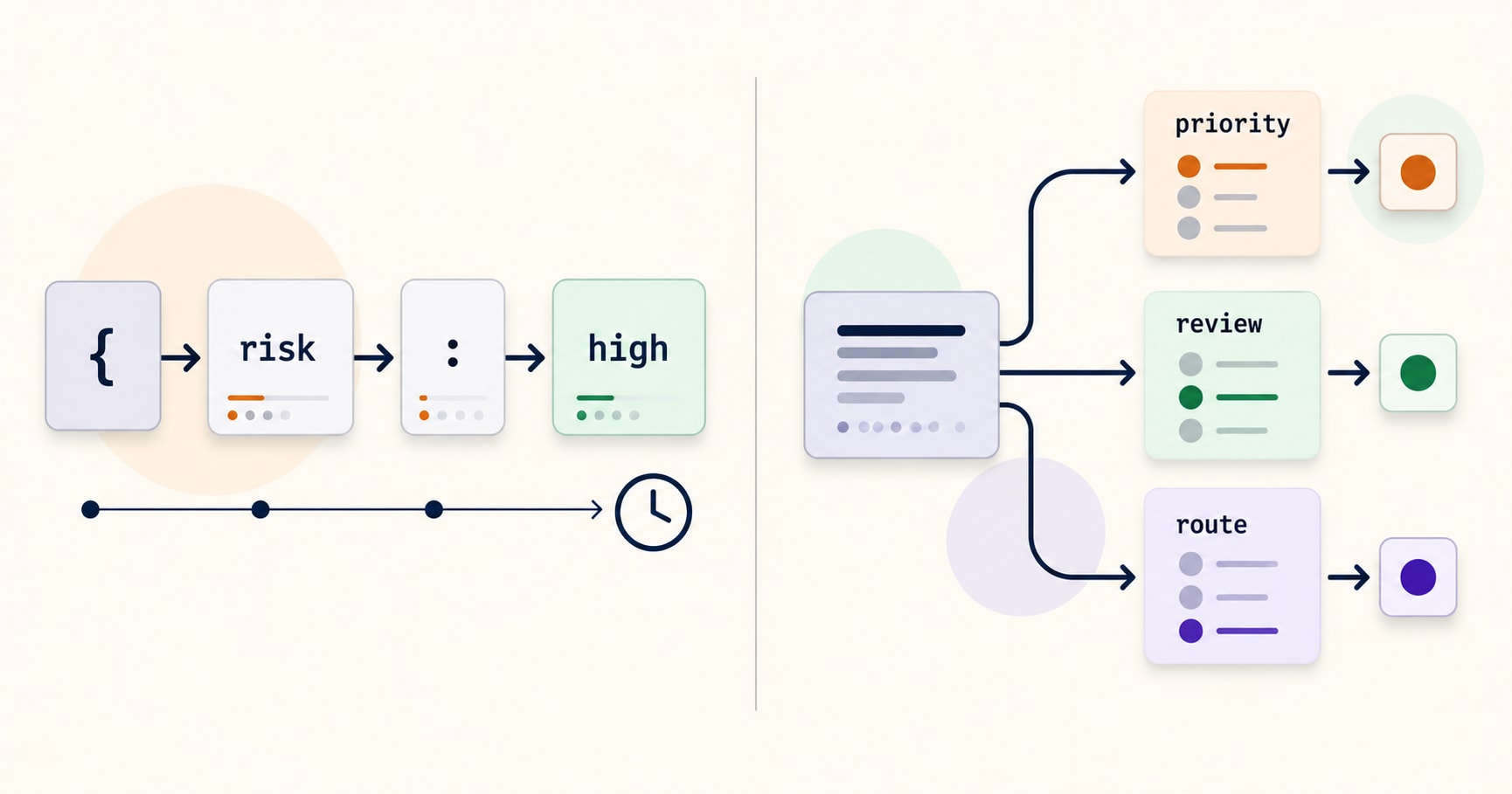
How Jev works starts with a simple observation: most software does not need an AI system to write an essay. It needs a dependable answer to a bounded question. Should this support ticket be escalated? Which queue owns it? Is the document complete? Should an agent stop and ask a person for help?
That is the premise of Jev, TypeSafe AI’s System One Model. It takes state, such as text or JSON, and returns typed decisions with probabilities and confidence. It is intentionally not a chatbot, and it does not generate free-form prose.
The headline claim is easy to misunderstand. Jev is not simply an LLM that produces better JSON. A more useful mental model is a decision engine: define the answers an application is allowed to act on, ask independent questions about the same state, and receive typed values that code can branch on without first parsing generated text.
A necessary caveat: TypeSafe has publicly described parallel decision evaluation, a new sampler, and RLCD, its training method for calibrated decisions. It has not disclosed enough architecture detail to verify claims that Jev is specifically a Qwen-derived decoder using a particular KV-cache implementation. This article separates the public interface from a plausible transformer-based explanation.
Why structured output is still often a generation problem
Language models can return JSON, and current APIs can constrain or validate it. Yet their work is still normally shaped around sequence generation. The model emits one token, then the next token conditioned on the preceding context, until it has produced braces, property names, punctuation, values, and closing braces.
Imagine this support message:
“I was charged twice after cancelling. I need this fixed today.”
An application might request:
{
  "queue": "billing" | "technical" | "account",
  "urgent": true | false,
  "needs_refund_review": true | false
}
With a generative model, the application asks for JSON, parses it, validates it, perhaps retries malformed output, and then branches. Constrained decoding reduces formatting failures, which is useful. It does not remove the fact that a machine-readable answer has been assembled as a sequence of output tokens.
For many short, bounded judgements, this mixes two distinct jobs: deciding what is true about the state, and spelling the representation of that decision.
How Jev works at the interface level
TypeSafe describes Jev as accepting shared state and a set of typed questions. A field is not an unrestricted response string. It represents a compact decision contract, such as a Boolean, a fixed Choice, or an ordered Score. The answer returns with a probability or confidence signal that software can use.
state: “I was charged twice after cancelling. I need this fixed today.”

questions:
  queue:               Choice(billing, technical, account)
  urgent:              Boolean
  needs_refund_review: Boolean

result:
  queue = billing
  urgent = true
  needs_refund_review = true
  confidence = ...
The exact API format varies by SDK. The important architecture is stable: the state is shared, the decision space is declared before the request, and each answer is a programmatic value. Vercel’s AI Gateway documentation says Jev evaluates declared questions in parallel and returns typed Choice, Score, and Boolean answers directly.
How Jev works compared with autoregressive decoding
Transformers can already process an input prompt in parallel during prefill. The important contrast is what happens once the prompt has been understood. A chat model normally enters an autoregressive decode loop, in which every new token becomes part of the context for the next. A long JSON object can therefore require many dependent forward passes even when it contains only three small decisions.
Jev’s public claim is that it avoids serially producing an output string and evaluates declared questions in parallel. Adding independent fields can still cost computation and input tokens, but it need not add another long chain of output-token steps.
| Task | Autoregressive LLM | Decision model pattern |
|---|---|---|
| Represent the answer | Generate a JSON string | Return typed fields |
| Many fields about one input | Generate a larger sequence | Evaluate declared questions over shared state |
| Format guarantee | Prompting, schema constraints, and validation | Answers limited to the declared decision contract |
| Open-ended writing | Suitable | Not the job |
Where KV cache and logits fit, and what remains unconfirmed
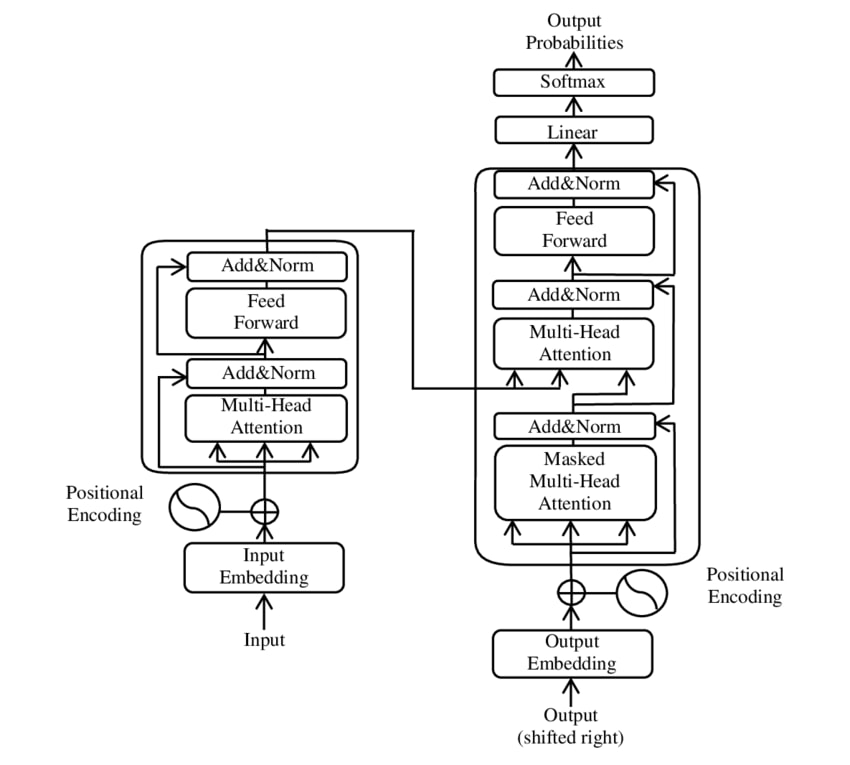
Some diagrams circulating with Jev explain the idea using a decoder-only transformer, a KV cache, and a restricted softmax. Those are legitimate concepts, but they are a conceptual reconstruction, not a reverse-engineered disclosure.
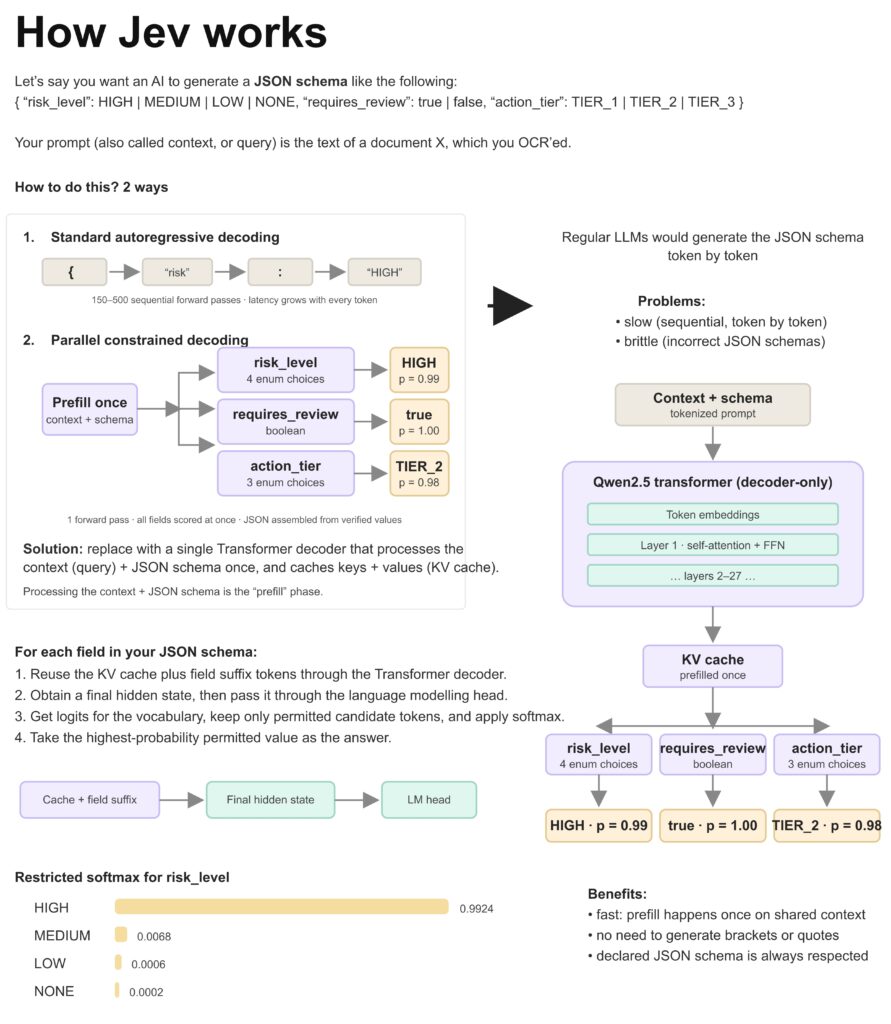
In ordinary decoder-only transformer inference, the prompt is processed once. Each attention layer stores key and value representations for its prompt tokens. This stored state, usually called a KV cache, lets later computation reuse prompt work rather than recomputing it. The next-token head produces logits, raw scores over a vocabulary, and a softmax converts selected scores into probabilities.
A generic constrained-classification design could build on that machinery. It could reuse shared context, score permitted values for a field, normalise only the allowed options, and select or report a distribution. That would explain why a model aimed at fixed choices can skip generating quotation marks, commas, field names, and closing braces.
It would still be inaccurate to claim that this is Jev’s exact implementation. TypeSafe says it built a new architecture, parallel sampler, and RLCD training method. Its public materials do not disclose the model family, layer count, cache layout, or token-level scoring algorithm. A clear boundary between known facts and architectural inference is more useful than a confident but unsupported diagram.
How Jev works when the output contract is narrow
Suppose a workflow must decide priority, owner, and whether human review is required. JSON syntax adds representational work that has no bearing on the actual decisions. A decision-only model can focus its response path on the permitted options.
This does not make semantic understanding free. The model must still understand the ticket, resolve ambiguity, and distinguish a billing issue from a technical fault. Nor does it turn a probabilistic model into a rules engine. It changes the output contract, which can eliminate a layer of string generation and parsing.
That leads to the useful engineering question: how many existing LLM calls are really bounded decisions disguised as text generation?
Type safety is not factual correctness
A valid answer can still be wrong. If a schema permits only billing, technical, and account, Jev can guarantee that it will not return sales or invalid JSON. It cannot guarantee that billing is the correct interpretation of a genuinely ambiguous message.
- Type safety protects the boundary between model output and program control flow.
- Accuracy measures whether the selected answer matches reality or an agreed label.
- Calibration asks whether a confidence of 0.9 corresponds to being right about 90 percent of the time for comparable cases.
TypeSafe’s own launch material makes the narrower claim: schema matching is guaranteed. That is valuable where malformed payloads or unexpected tool names would break automation. It is not proof of correctness, fairness, safety, or calibrated confidence in a new domain.
How Jev works with confidence thresholds
Confidence matters only when it changes what the workflow does. A support system might auto-route a ticket only when its decision confidence clears a threshold, otherwise send it to review.
if queue.confidence >= 0.92 and urgent.confidence >= 0.90:
    route_to(queue.value)
else:
    send_to_human_review(ticket_id)
Those values are policy decisions, not magic defaults. They should come from labelled examples that resemble the real workload. Pydantic AI’s integration guidance likewise says its threshold example comes from a small internal support-ticket set and that developers should measure accuracy and hand-off rate on their own data.
The threshold must reflect the cost of an error. A low-risk email triage workflow can automate more aggressively than refund approval, account recovery, clinical communication, or an irreversible action.
Ask one fast judgement per field
The strongest design advice in the available integration documentation is simple: make each field one judgement that a knowledgeable person could make quickly. Do not bury a committee meeting inside one Boolean.
Weak question:
is_good_customer = “Is this a valuable, feasible, low-risk customer opportunity?”
Better decomposition:
has_budget = “Is there evidence of an approved budget?”
fits_target_market = “Does the organisation match our target market?”
requires_legal_review = “Does the request raise a contractual or compliance concern?”
Application code can then combine those values deterministically. This keeps model judgement separate from business policy, makes failures inspectable, and creates labels that can be evaluated independently.
Where a decision model fits, and where it does not
Jev suits decision-shaped tasks with a finite action space: routing, classification, extraction into known fields, risk scoring, guardrails, and agent-control decisions. Vercel lists choosing the next tool or subagent, deciding whether to retry or ask the user, scoring urgency, and verifying outputs as example uses.
It is not the right component when output must be created. Writing a customer reply, producing code arguments, conducting a long multi-step analysis, performing arithmetic, or interpreting images needs a different component. A sensible system can use a decision model to decide whether to call a generative model, then let the LLM write when language is genuinely the product.
How Jev works in a production evaluation loop
Do not begin with a vendor benchmark. Begin with a small labelled set from your own workflow, including cases that normally create disagreement between reviewers.
- Define a narrow contract, with an explicit unknown or needs review route where appropriate.
- Collect representative, ambiguous, adversarial, and missing-information cases.
- Measure accuracy per field, not only whole-record accuracy.
- Plot accuracy against confidence to assess calibration in your domain.
- Choose automation thresholds from error cost and review capacity.
- Log the state version, question definitions, answer, confidence, threshold, outcome, and later human correction.
TypeSafe’s published figures are a reason to test, not independent proof for every workload. Its 193.6x faster and 444.6x cheaper claims come from its workflow evaluations, and the company says these are likely near the high end of real-world gains. The same launch post discloses limitations, including team-authored workflows and reference probabilities averaged from external models.
The practical takeaway
Jev makes a neglected category explicit: machine decisions that do not need to become prose first. The important idea is not that JSON is bad or that LLMs are obsolete. It is that a system should pay for open-ended generation only when it needs open-ended generation.
For everything else, define the decision boundary carefully, make each field narrow, measure confidence on your own data, and retain human review where the consequence of error demands it. That is how a typed decision layer can make automation faster and easier to control.
Sources and further reading
- TypeSafe AI, Introducing System One Models and Jev
- TypeSafe AI, Jev overview and FAQ
- Vercel, Jev on AI Gateway
- Pydantic AI, TypeSafe integration guidance
- Vaswani et al., Attention Is All You Need
For a related explanation of generative-model latency, see Why LLMs Pause Before They Start: Time to First Token Explained.