
MCP vs API: What’s the Difference, and How Do They Work Together?
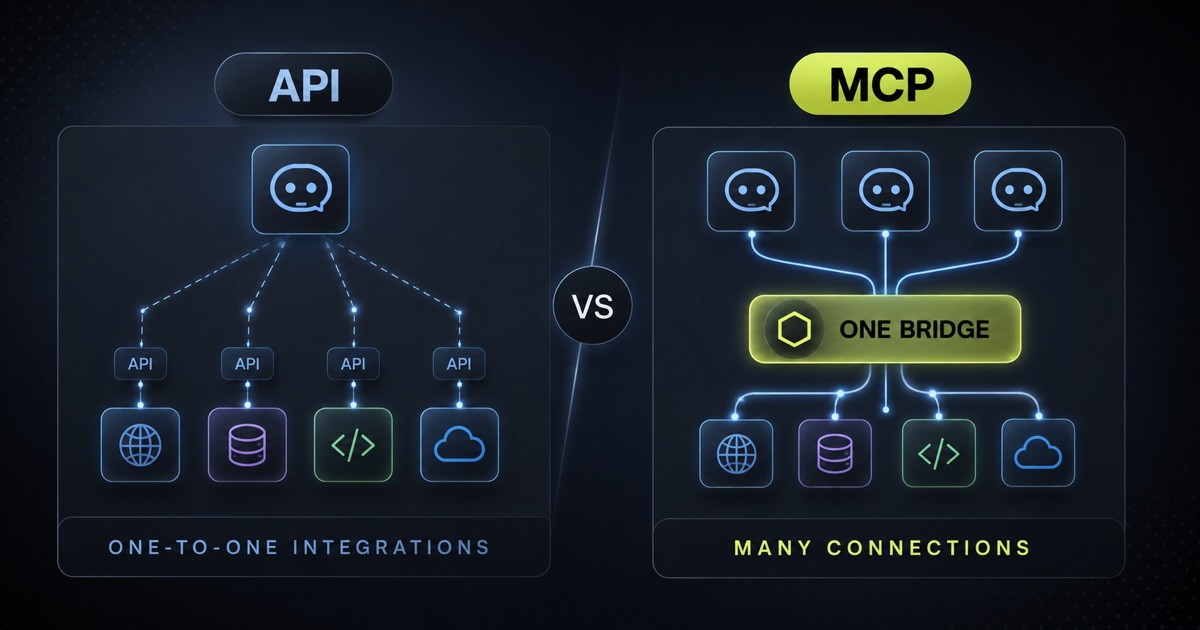
If you are comparing MCP vs API, the short answer is that they solve different integration problems. APIs expose capabilities; MCP gives AI applications a standard way to discover and use tools and context.
Key takeaway: An API is a contract for interacting with a system. MCP is a protocol that helps AI applications discover and call tools through a common interface. In practice, MCP often sits above existing APIs.
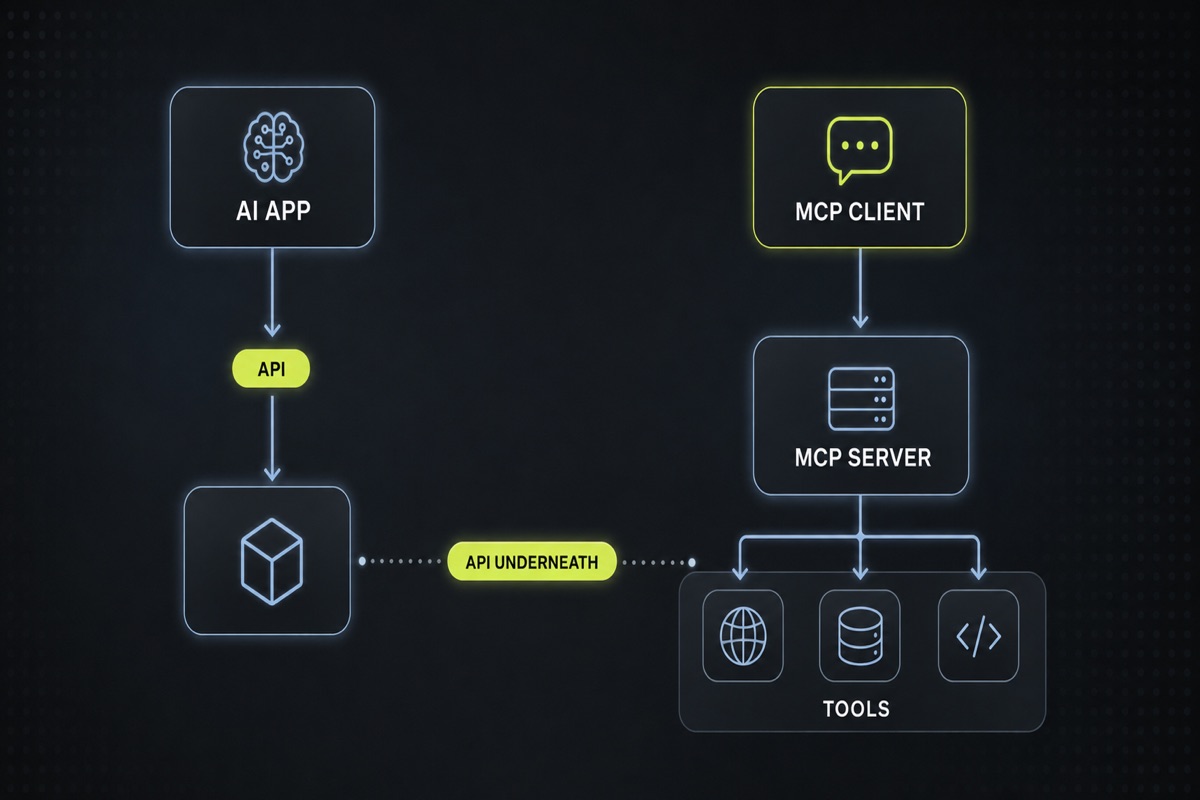
The useful distinction: An API defines how software interacts with a system, while MCP defines a common way for an AI application to discover and call capabilities.
At a glance: MCP vs API
| Question | API | MCP |
|---|---|---|
| What is it? | A contract for software interaction | A standard protocol for AI-to-tool interaction |
| Who usually chooses the operation? | The developer or a fixed workflow | The AI application, using discovered tool definitions |
| What does it expose? | Endpoints, inputs and outputs | Tools, resources and reusable prompts |
| Best fit | Known, repeatable integrations | Assistants that need to discover and choose capabilities |
What an API does
An application programming interface is a contract. It describes the operations available and the inputs and outputs a caller should expect.
For a typical web API, a developer builds an integration that sends requests to particular endpoints, supplies authentication and handles responses. A blogging platform, for example, might accept a title, content and publication status when creating a post.
Once that integration exists, nobody needs to construct each request manually. A website, scheduled workflow or AI tool can invoke it.
What MCP adds to an API
The Model Context Protocol gives connected applications a common way to discover available tools and call them. Servers can also expose resources and reusable prompts. Its client-server architecture allows integrations with local programs as well as remote services. See the official MCP architecture overview.
A tool definition includes structured information, such as its name and input schema, alongside a description. The AI application can use that information to select a tool and construct arguments. MCP calls still require valid inputs; natural language does not replace the tool’s contract. The MCP tools specification describes this discovery and invocation model.
Think of MCP as the coordination layer
MCP does not make APIs disappear. In many cases, an MCP server uses existing APIs behind the scenes and presents their capabilities in a form that AI applications can discover and reuse.
A practical MCP vs API example: creating a blog draft
Imagine asking an assistant: “Create a draft post explaining our new reporting feature.”
One possible implementation works like this:
- Prepare: the assistant creates a title and article.
- Discover: it selects a blogging tool exposed by a connected MCP server.
- Call: the application sends a structured request containing the title, body and draft status.
- Complete: the server calls the blogging platform’s API and returns the result.
The user describes the outcome. The assistant prepares the request. The server performs the integration work. The blogging platform still stores the post.
This is an illustrative workflow, not a guarantee that every assistant or server behaves identically.
Does MCP replace APIs?
Usually, no. An MCP server often wraps an existing API. It can also work directly with files, databases or other software, so an underlying web API is not a requirement.
MCP itself does not translate a sentence into an action. Interpreting intent belongs to the AI application and its model; MCP standardises the exchange with the server.
That distinction matters when troubleshooting. Choosing the wrong tool and failing an underlying API request are different problems, even if both appear to the user as an unsuccessful action.
When would you use each?
| Choose a direct API when… | Consider MCP when… |
|---|---|
|
|
Adding a server does not automatically make a service usable by every AI client. Compatibility, credentials, permissions and the operations the server exposes still determine what is possible.
Before choosing an integration approach, ask: does this workflow need a fixed integration, or an assistant that can discover and choose tools?
If you are exploring the wider design space, this comparison of AI agent frameworks provides useful context on how tool-using assistants are assembled.